Why I don’t do many forward folds…
If you have been practising Yin with me for a while, you may have noticed that I don’t include many forward folds in my classes. It is something I have become increasingly conscious of over the years, not because I believe that spinal flexion is bad or that forward folds have no place in a yoga practice, but because I have started to ask myself a much more important question: what does our body actually need?
When we look at the way most of us live, the answer is often not more flexion.
So much of our everyday life takes place with the body moving forwards. We sit at our desks, drive our cars, look at our phones, work on computers, cook, clean, read, write, garden and pick things up from the floor. Even when we think we are resting, we can often be sitting with our shoulders rounded, our head slightly forward and our spine adapting to a flexed position.
Our arms are usually in front of us. Our eyes are in front of us. Our attention is often directed forwards. We spend hours reaching, looking and leaning towards the world in front of us.
Flexion is a completely natural movement of the spine and one that we need. Our spine was designed to move in many different directions, and healthy movement is not about avoiding one particular direction. But when I think about the amount of flexion we already experience throughout the day, I don’t always feel that our yoga practice needs to reproduce it for another hour.
This is where my approach to Yin has gradually evolved. I am much more interested in creating balance within the practice than in collecting particular yoga shapes. If the body has spent most of the day in a forward position, perhaps it is worth giving it an opportunity to experience extension. If the thoracic spine has spent hours adapting to sitting and looking forwards, perhaps we can give some attention to opening and mobilising that area. If the shoulders have been working in front of the body all day, perhaps we can explore what it feels like to create some space across the chest.
For me, this is one of the most interesting aspects of functional Yin. The question isn’t whether a particular pose is traditionally considered a Yin pose. The question is what we are asking the body to experience and whether that experience is appropriate for the person practising it.
The spine is an extraordinary structure. It gives us stability while allowing movement, protects the spinal cord and constantly adapts to the demands we place upon it. It flexes, extends, rotates and moves laterally, and the different regions of the spine have different roles and different capacities for movement.
I particularly enjoy working with the thoracic spine because it can become so easily overlooked. We often think about stretching the hamstrings or opening the hips in yoga, but the middle and upper back can spend a considerable amount of time in a rounded position without us even noticing it.
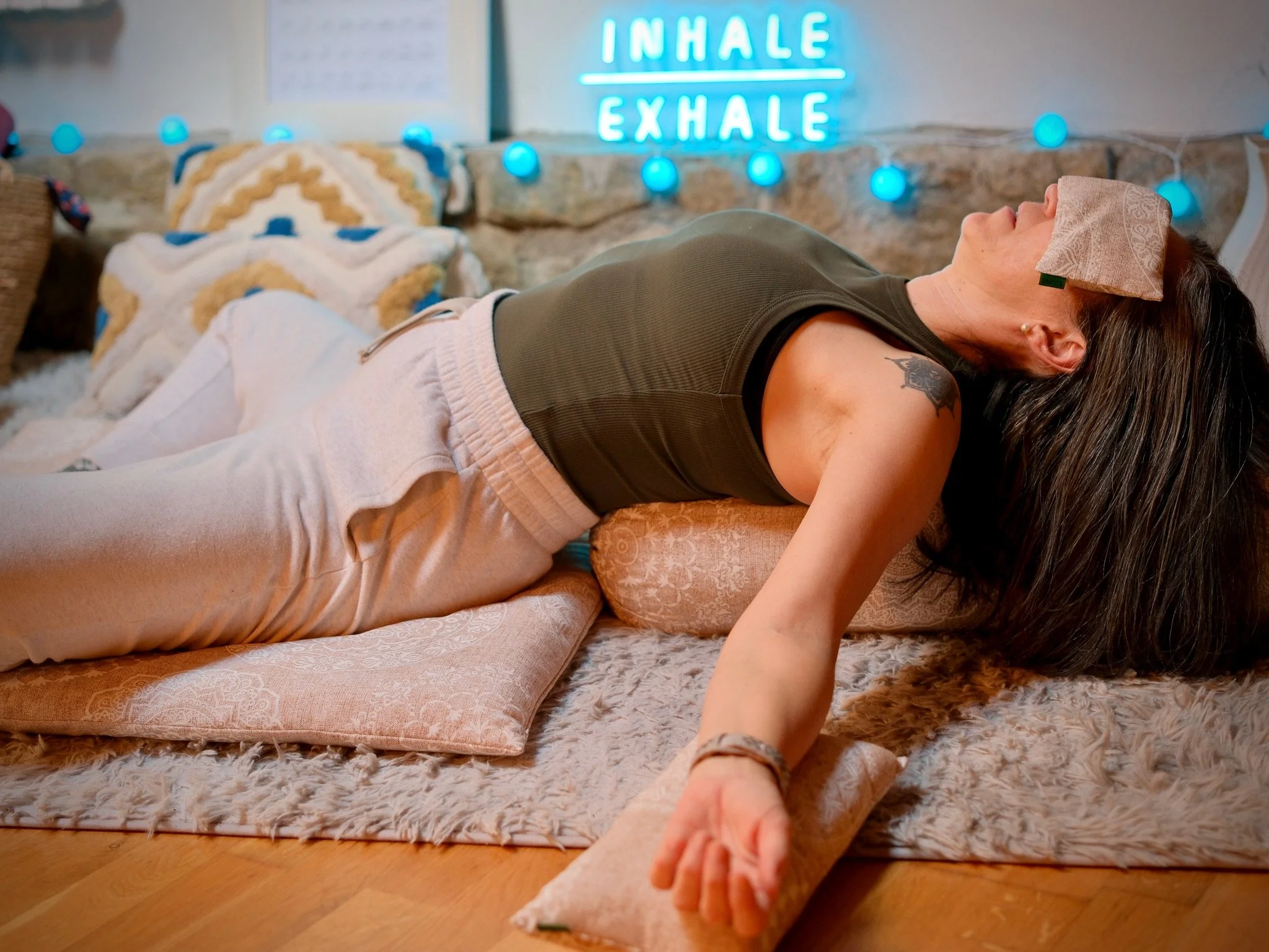
Working with extension doesn’t mean trying to create dramatic backbends. In fact, I am not particularly interested in how deep someone’s backbend is. Extension can be very subtle. It can be the gentle opening of the chest over a bolster, a small amount of movement through the thoracic spine or simply becoming aware of how the ribs and upper back move when we breathe.
Menopause and how to adapt:
This becomes an even more interesting conversation as we move through menopause. Recently I had the pleasure of meeting Niamh Daly. An incredible teacher that has specialized on Menopause yoga and bone health.
The hormonal changes associated with menopause, particularly the reduction in oestrogen, can have an important impact on bone health. Bone loss can accelerate during the menopausal transition, which means that midlife is an important time to start paying greater attention to bone strength, muscular strength, balance and the way we load our bodies.
The spine is particularly relevant because osteoporosis can affect the vertebrae and increase the risk of vertebral fractures. These fractures are not always the result of a dramatic fall or accident and can sometimes occur with relatively ordinary movements or loads when bone density is significantly reduced.
This does not mean that menopause makes forward folds dangerous, nor does it mean that women going through menopause should be afraid to bend their spines. It does mean that we should become more aware about our individual bone health and more thoughtful about how we practise.
For someone with osteoporosis, particularly osteoporosis affecting the spine or a history of vertebral fractures, deep spinal flexion can place additional stress on the vertebrae. This is why osteoporosis classes recommend modifying or avoiding deep forward bending, particularly when the spine is loaded or taken towards its end range.
That distinction is important to me because I don’t want yoga to become another place where women are told that their bodies are fragile or that they should be afraid of movement. Quite the opposite. I want us to become more knowledgeable about our bodies so that we can continue moving with confidence and awareness as we get older.
There is a significant difference between moving with curiosity and forcing ourselves into a shape because we believe that going deeper must somehow be better.
This is also why I don’t teach every student in exactly the same way. A pose that feels wonderful for one person may not be appropriate for another. Someone with healthy bones and good spinal mobility may have a completely different experience from someone with osteoporosis, a previous vertebral fracture, chronic pain or a history of spinal injury.
The functional approach
And again here is where I keep repeating: The shape is only one part of the practice.
What matters is how we arrive there, where the movement is coming from, what tissues are being loaded and whether the experience makes sense for that particular body.
Sometimes the most intelligent practice is to use more support, it is to stay higher, it is to make the movement smaller, it is to choose a different variation altogether.
And sometimes it is simply to recognise that we don’t need more of something just because yoga has traditionally given it to us.
This is why I love incorporating more extension and thoracic work into my Yin classes. After a day of sitting, driving, working, looking at screens and constantly reaching forwards, there can be something incredibly nourishing about gently opening the front of the body and allowing the upper back to move in another direction.
It is not about making extension the new goal or deciding that backbends are better than forward folds. I don’t want to replace one rule with another. Our spines need flexion, extension, rotation and lateral movement. They also need strength, stability and rest.
What I want is for our yoga practice to become responsive rather than automatic.
Instead of asking ourselves how deeply we can move into a pose, we can begin to ask what our bodies have already experienced that day and what they might benefit from experiencing differently.
That is particularly meaningful to me as a woman moving through midlife. Menopause has changed my relationship with my body and with my practice. I have become less interested in how flexible I can be and much more interested in how I can continue to move, strengthen, adapt and understand my body as it changes.
Perhaps that is one of the gifts of getting older. We begin to realise that yoga isn’t about mastering our bodies. It is about learning to listen to them.
And sometimes listening means recognising that after a whole day spent folding forwards, the kindest thing we can give our spine is the opportunity to move in the opposite direction.
A short Yin practice for the spine
Constructive rest with block — 8 minutes
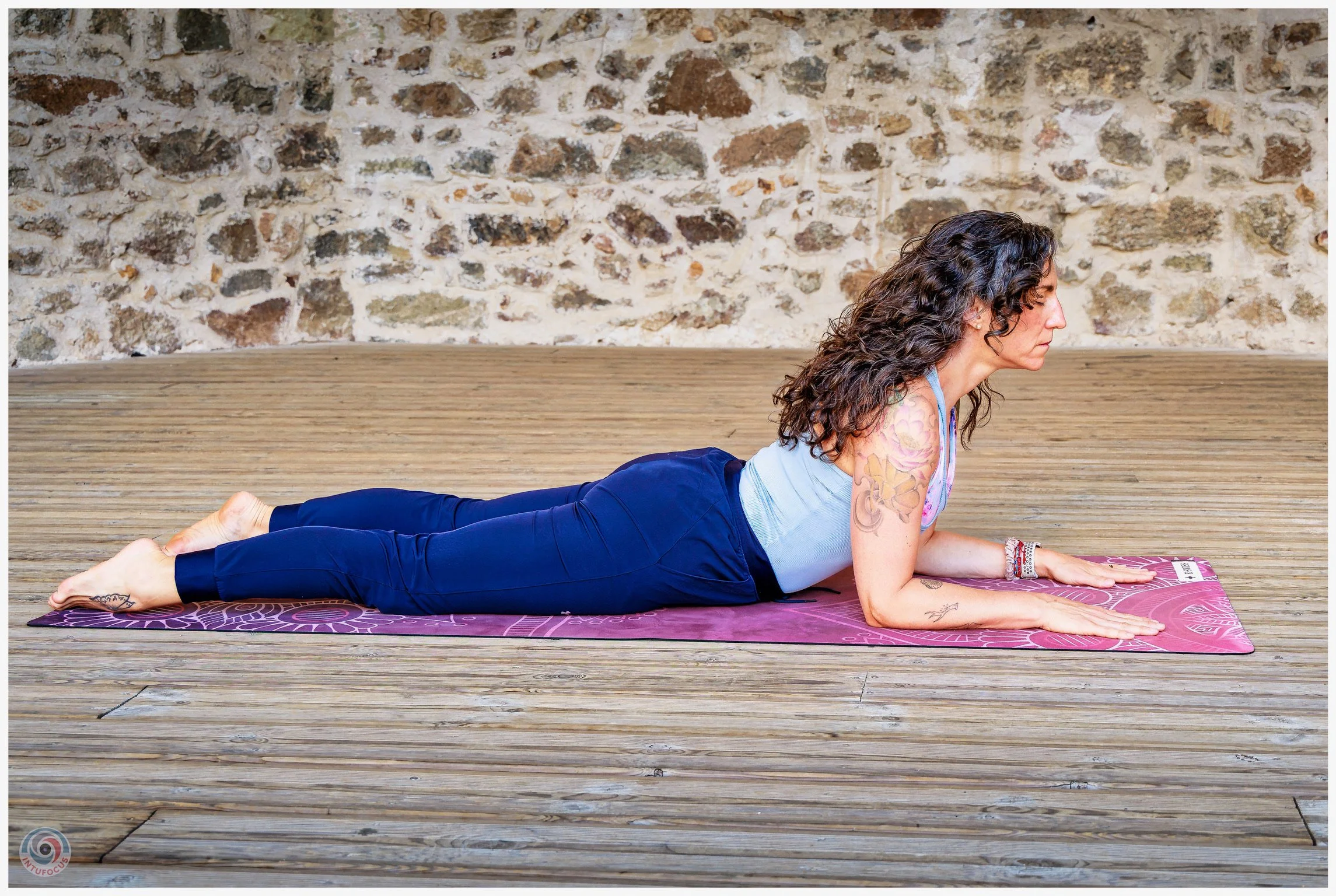
Sphinx — 4 minutes
Supported Thoracic Extension over a Bolster or block — 4 minutes
Melting Heart — 3 minutes
Closed wings 3 minutes each side
Supported Bridge — 4 minutes
Savasana — 8 minutes
If you have osteoporosis, a vertebral fracture, significant bone loss or a spinal condition, this sequence should be individually adapted with appropriate professional guidance.