

Everyone Should Have a Village
My sister said it almost without thinking as we were driving home: “Everyone should have a village.” It was such a simple sentence that, under different circumstances, I might have forgotten it moments later. Instead, it stayed with me for the rest of the day. The more I thought about it, the more I realized that perhaps she had put into words something many of us feel without knowing how to describe it: the longing for a slower, simpler way of living, and for a place where we can feel that we truly belong.
When we were children, my sister and I used to dream about having a village of our own. While other children imagined holidays at the beach, amusement parks, or faraway adventures, we imagined returning to the same place every summer. In our minds, it was somewhere time moved differently, where mornings lasted longer and afternoons seemed endless. We imagined houses with open doors, streets where children could wander freely, and neighbors who knew one another by name. We didn't have the words for it then, but what we were imagining was more than a physical place. We were imagining a particular kind of life.
Strangely, that dream came true many years later.
This week, as I watched my niece and nephew running through the streets of the village, I found myself wondering whether the village itself had ever really been what we were longing for. Perhaps what we wanted was the life that happens within it. The sense of belonging. The familiarity. The feeling that there is nowhere else you need to be and nothing more important waiting for your attention. A village has a remarkable ability to remind you who you are once you stop rushing long enough to notice.
Here, mornings begin slowly. Breakfast can stretch far beyond the time it would normally take to eat because nobody is in a hurry to get up from the table. Conversations don't have to compete with phone notifications, emails, or the constant temptation to check what is happening somewhere else. People talk, they listen, and there is room for silence without anyone feeling the need to fill it. Nothing remarkable seems to be happening, and yet somehow those ordinary moments feel like the most important ones.
The same thing happens in the afternoon. Neighbors bring chairs outside, people stop to talk, and someone can ask how you are without it being merely a polite question. They actually wait for an answer. Children disappear for hours, moving from one game to another, and the adults don't need to know their exact location every minute. You simply hear their voices and laughter somewhere in the distance and trust that they are having the kind of childhood that cannot be planned on a calendar.
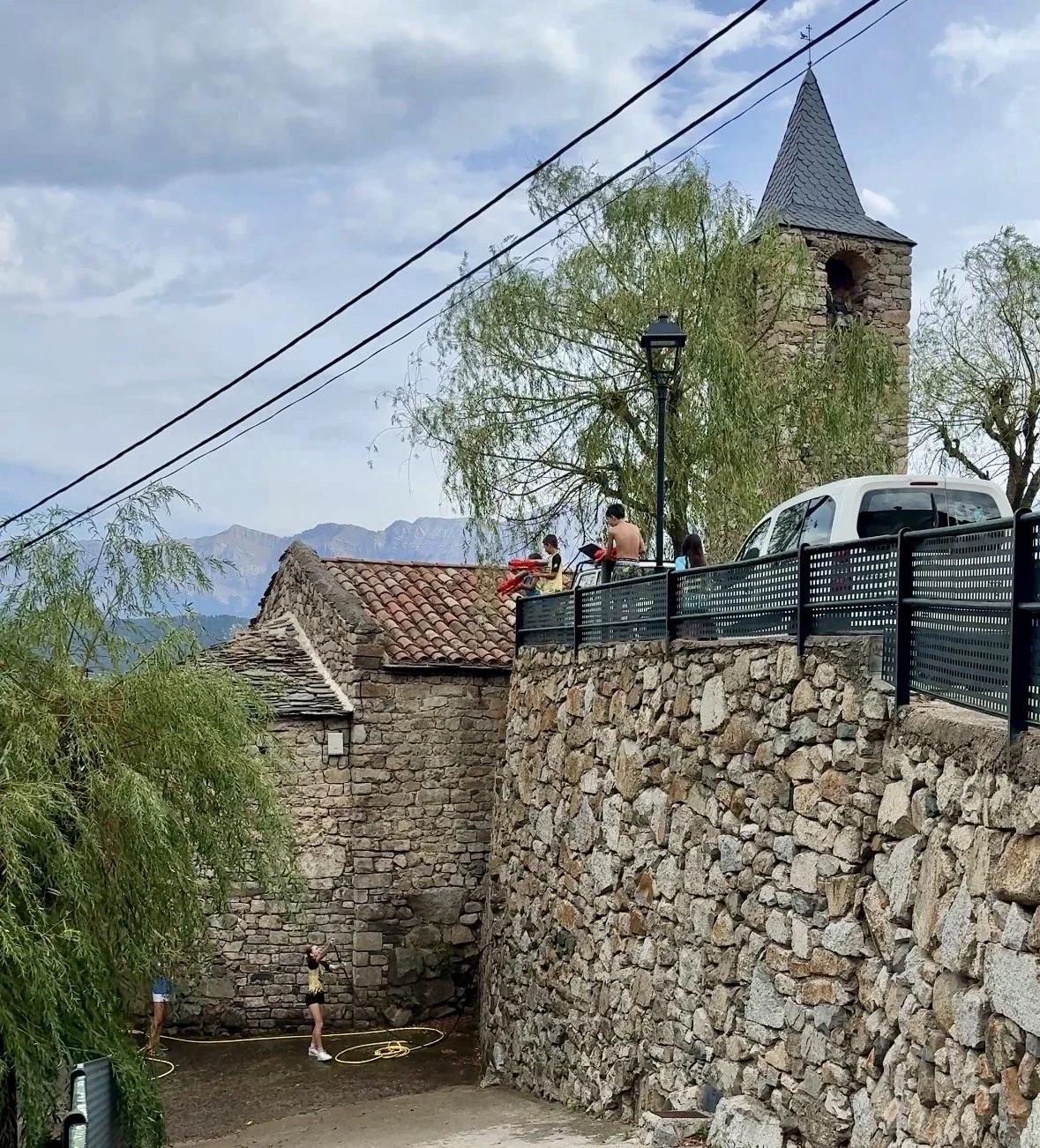
This week, the children came back home completely soaked after a water fight. They were exhausted and absolutely delighted with themselves. One of them had a scraped knee, which he showed us almost proudly, as though it were a trophy rather than an injury. Looking at him, I couldn't help thinking about how differently we adults approach life.
We spend so much of our time trying to prevent anything from going wrong. We organize our days carefully, plan ahead, monitor every detail, and worry about all the things that could happen. We try to protect ourselves and the people we love from discomfort, disappointment, failure, and even the smallest scratches. And while we are busy preparing for everything that might go wrong, we sometimes fail to notice how much of life is happening perfectly well in front of us.
The children weren't thinking about any of that. They were simply playing.
They weren't worried about getting dirty or looking ridiculous. They weren't thinking about whether anyone had captured the moment on camera. They weren't calculating how much time they had left before the next activity. They were completely absorbed in what they were doing, which is something many of us find increasingly difficult as adults.
That evening, another one of those simple moments happened. We sat outside the house after dinner, with no television playing and our phones somewhere inside. There was nowhere we needed to go and nothing we needed to accomplish. There was simply the night around us.
Slowly, the stars began to appear above the mountains. Someone started talking about what had happened that day, and before long the conversation had moved backwards through time, bringing up stories from twenty years ago. We laughed about people who were no longer there, remembered things we had almost forgotten, and told stories that had somehow survived all those years.
Nobody was looking at a screen. Nobody needed to find something else to occupy their attention. There was no need for entertainment because life itself was already happening around us.

And I found myself wondering when we had stopped looking up.
When did we stop sitting outside simply because the evening was beautiful? When did we become so accustomed to documenting our experiences that we sometimes forget to experience them? At what point did taking a photograph of a sunset become more important than standing still and watching it disappear?
Perhaps this is one of the reasons a village can feel so restorative. It isn't because village life is perfect. It isn't. There are problems, disagreements, inconveniences, and difficult days everywhere. A village doesn't magically remove any of those things. What it can offer, however, is something that modern life often makes surprisingly difficult: permission to slow down.
In a village, you are reminded that happiness rarely arrives dramatically. More often, it hides inside ordinary moments. It is a long breakfast that nobody wants to end. It is a conversation with a neighbor while standing in the street. It is the smell of damp earth after the garden has been watered. It is children returning home covered in mud after spending the entire afternoon outside. It is a scraped knee that becomes a story. It is sitting beneath a clear night sky. It is someone knocking on your door without having sent a message first.
None of these things are particularly impressive. They probably wouldn't make an interesting social media post. Yet they are the moments we tend to remember.
Perhaps that is because they remind us that a meaningful life is not necessarily a life filled with more. We have become very good at accumulating things, experiences, information, and distractions. We are constantly encouraged to want the next thing: a better house, a more exciting holiday, a newer phone, a fuller schedule, another achievement. But sometimes the greatest luxury is the opposite. Sometimes the luxury is having less to worry about, fewer places to be, fewer things demanding our attention, and more time to simply be present.
Not everyone can live in a village, of course. Life takes us to cities, to different countries, to demanding jobs and busy schedules. Many of us have responsibilities that make a slower pace difficult to maintain. But perhaps we don't need to move to a village to bring some of its wisdom into our lives.
We can start in small ways.
We can put our phones away during dinner and give the people sitting across from us our full attention. We can go for a walk without headphones and allow ourselves to hear the world around us. We can sit outside at night and look at the stars before going to bed. We can have a conversation without checking the time every few minutes. We can allow children to play without turning every afternoon into a carefully managed activity. We can let them come home tired, dirty, and happy.
Most importantly, we can remind ourselves that life is not happening somewhere else.
It is not waiting for us inside our phones. It is not happening on the next holiday, after the next promotion, when we finally have more free time, or when everything is organized exactly as we want it to be.
Life is happening now.
It is happening around shared tables and in conversations that last longer than expected. It is happening in streets filled with children's laughter, in spontaneous visits, in unplanned afternoons, and in hugs that nobody thinks to photograph. It is happening in the quiet moments when we sit beside someone we love and don't need to say anything at all.
Maybe that is what my sister meant when she said that everyone should have a village.
She wasn't necessarily talking about a particular place on a map. She was talking about belonging. About community. About having somewhere that reminds you to slow down and people who make you feel that you don't have to be in a hurry all the time.
A village is, in that sense, much more than a place.
It is a way of coming home.
And perhaps we all need to find our own version of it, somewhere, or somehow, we can step away from the noise, put down our phones, look around at the people we love, and remember that we don't have to chase every moment.
Sometimes we only need to live it.